

Let’s be honest, if you’ve ever watched a Kung Fu class from the sidelines, forms can look a bit…repetitive.
A group of students moving through the same sequences every week. No sparring. No dramatic takedowns. Just patterns.
So it’s a fair question: Why do we spend so much time on them?
In traditional systems like Wing Chun, forms aren’t filler; they’re the foundation. And once you understand what they’re actually doing for the body and brain, they start to make a lot more sense.
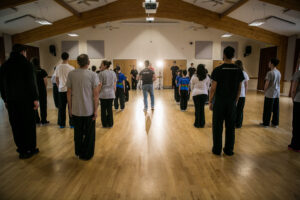
When we practice a form, we’re not just “going through the motions.” We’re teaching the body to remember the movements and understand where your arms are in comparison to the body.
Every stance held with structure.
Every punch delivered with acceleration.
Every turn performed with control and purpose.
Do it once and it’s awkward.
Do it fifty times and it starts to feel smoother.
Do it a few hundred times and your body just knows.
That’s muscle memory. And when pressure kicks in during sparring, gradings, or just a stressful moment, your body doesn’t panic. It responds.
Your forms work with your chi sau exercises to make your reflexes reliable, and reliability instils confidence.
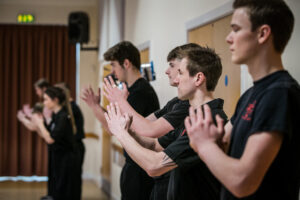
There’s something quietly powerful about committing to improve the same sequence over time.
Forms teach patience. You don’t “complete” a form and move on. You refine it. You notice the tiny details. You pick up on when your stance is off, or you aren’t accelerating on your hits; there is always something to target.
For children especially, this is huge.
We live in a world of instant everything. Scroll, tap, swipe, done. Forms are the opposite. They say: slow down, improvement comes with time.
And that lesson spills over into school, friendships, and life in general.
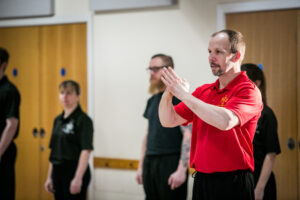
Here’s something interesting: the more predictable something is, the easier it is to focus inside it.
A form has a clear beginning, middle and end. The order doesn’t change. That certainty actually frees up mental space. Instead of worrying about what’s coming next, students can concentrate on how they’re moving.
It becomes a kind of moving meditation.
If attention tends to wander (as it does for most of us!), the pattern gently pulls it back. Miss a movement? You feel it. Lose your balance? You notice. The structure keeps you present.
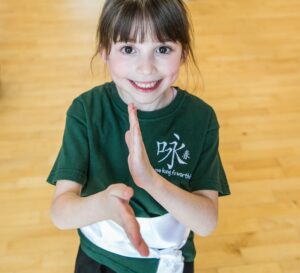
Children need structure. It makes the world feel manageable.
When they know what to expect, their nervous system settles. That’s why routines at home matter. It’s why consistent boundaries matter. And it’s why forms work so well in martial arts training.
Each time a child performs a form, they’re stepping into something familiar. That familiarity builds confidence. They can measure progress. They can feel themselves getting stronger.
Structure doesn’t squash personality, it gives it something solid to stand on.
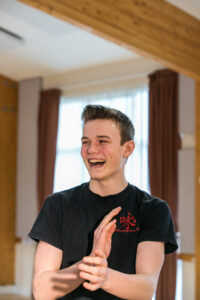
This becomes even more powerful for neurodiverse students.
Predictable patterns reduce overwhelm. Clear expectations reduce anxiety. Repetition creates safety.
For students with ADHD, autism, or sensory processing differences, forms can be incredibly regulating. The steady rhythm and breathing patterns can reduce that chaotic feeling inside. The fact that you know exactly what comes next makes things very clear.
And inside that clarity, growth happens.
If you’ve never tried Kung Fu because forms looked intimidating, or you worried it would be too rigid, maybe it’s time to rethink that.
Forms aren’t there to limit you. They’re there to support you.
And whether you’re a parent considering classes for your child, someone who’s neurodiverse and looking for a grounded way to move, or an adult who just wants to try something different, you don’t have to be “naturally good” to start.
You just have to start.
Come and experience it for yourself. Step into the pattern and see how it feels!
You might be surprised at how much freedom you find inside the structure.